Technology
How water becomes
clean.
If you are looking for filters to improve the drinking water at home or at work, reverse osmosis filtration is one of the most popular and most effective methods available.
Stage 01 · 20 µm
Sediment filter
The first pre-filter catches everything visible to the naked eye — sand, rust from the pipes and coarse particles that would damage the later stages.
Stage 02 · carbon
Carbon block filter
Activated carbon binds chlorine, chloramines and organic compounds that give water an unpleasant smell and taste.
Stage 03 · 5 µm
Sediment filter
A second sediment stage, four times finer — it protects the membrane and removes cloudiness.
Stage 04 · 0.0005 µm
RO membrane
The heart of the system. Water is forced through a semi-permeable membrane, while contaminants are held back and flushed down the drain.
Stage 05 · final
Post-carbon filter
The final filter “polishes” the water from the tank before it reaches the tap — so every glass has the same clean taste.
Particle size · microns (µm) · logarithmic
RO · UF · softener
Three technologies, one table.
| Property | Reverse osmosis | Ultrafiltration | Water softener |
|---|---|---|---|
| Principle | semi-permeable membrane under pressure | membrane, hydrostatic pressure | ion exchanger (resin + salt) |
| Pore / filter | 0.0005 µm | 0.01 µm | — |
| Removes | chlorine, limescale, heavy metals, nitrates, pesticides, bacteria | suspended solids, sediment, small numbers of bacteria | calcium and magnesium ions (limescale) |
| Where | under the sink or as a stand-alone dispenser | hot and cold water dispenser | where the water supply enters the house |
| What for | drinking and cooking water | drinking water | protecting water heaters, washing machines, boilers and coffee machines |
Applications
From the kitchen sink to the whole building.
RO is hugely popular in homes and businesses around the world: it produces great-tasting water, it is efficient and reliable, filtration is fully automatic, and the systems are affordably priced.
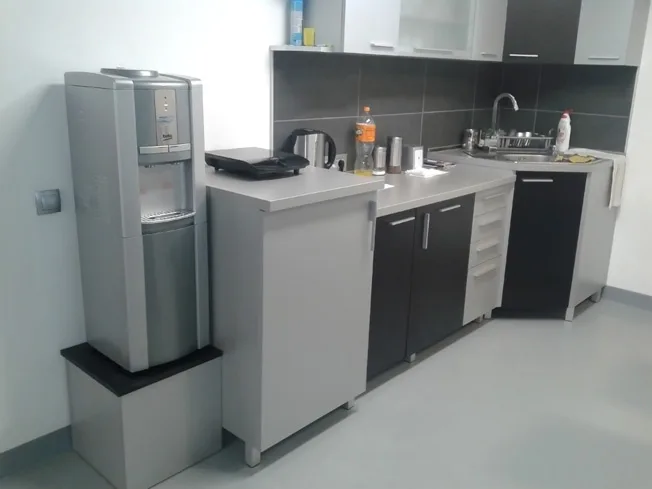
Under the kitchen sink
A compact RO system fits inside the kitchen cabinet and delivers top-quality water from a dedicated faucet. It can also be connected to a dishwasher and an ice maker.
Whole house (POE)
A whole-house system is connected to the main water line entering the home and is usually installed in the garage or a utility room. Because of the cost and long-term maintenance, it is not always the best option — ask us.
Commercial premises
There is a wide range of RO systems for commercial use: food and beverage, agriculture, hospitals, hotels, mining, the military, pharmaceuticals, energy and public institutions.
